March 27, 2026

The last two weeks we have looked at a biblical identity of manhood. We know that identity has been tarnished from the sinfulness of humanity that began in Genesis 3. We also know men today are searching for meaning and purpose in the false male identities Satan offers them as easy and poor substitutes for the identity God has called them to, a biblical identity that will provide true meaning and purpose to their lives. 

I Corinthians 16:13 challenges men with this statement: “Be watchful, stand firm in the faith, act like men, be strong.”  Act like men! What does that mean? The worship of female deities in ancient Corinth was a significant aspect of the city’s religious life, which was quite different from most Greco-Roman cities. One of the prominent goddesses was Aphrodite, the goddess of love, beauty, and fertility. Aphrodite was worshipped in various temples and shrines throughout Corinth, and the prominence of this female statue skewed the relationship between men and women. Like today, they tried to blur the genders, resulting in women seeking to be like men and men thinking they could be like women. As a result, men in turn shrunk to the shadows and everyone was hurting because of it. It is evident from even a casual reading of 1 Corinthians that this dynamic had penetrated the church, and Paul was writing to correct that problem. I suppose that, to address the issue, Paul could have cast a large blanket of blame on the government of the day or he could have rebuked the women, but he did not do that. Paul spoke directly to the men of the church to accept the responsibility God had given them by re-engaging the biblical male identity: “Act like men.” 

Calling men to act like men does nothing to diminish the significance and purpose of women. But what it does is challenges men to re-engage in their biblical identity, with the unique responsibility God has given to them. When men act like biblical men they will be fulfilled in their purpose, women will blossom, children will be nurtured and society will be a blessing to all the citizens of the community. Join me this Sunday as we conclude this series on The Male Identity. 
March 22, 2026

Earlier in my ministry when I pastored a church that wasn’t able to offer a children’s church like we do I included a children’s message during the worship service. I tried to take a biblical truth from my message that day and relate it to children by doing an object lesson. One I remember doing was on the security we have as God’s children. I would take a quarter and hold it in my hand tightly and challenge any of the kids to try to get the coin free from my hand. When a few of them would try and fail they could understand the scripture that says of our relationship with God “No one can pluck us from the father’s hand.” We all like good object lesson because they can bring abstract concepts down to reality.
God likes using object lessons to amplify and illuminate spiritual truth. You may not have thought this before but our lives as Christians are to be an object lesson for the people around us and the angels in heaven. It’s safe to see that people and angels are watching us. One of the ways our lives are object lessons is through the created order of men and women and the way our relationships reflect that our origins are from God, reflecting His power, creativity and love.
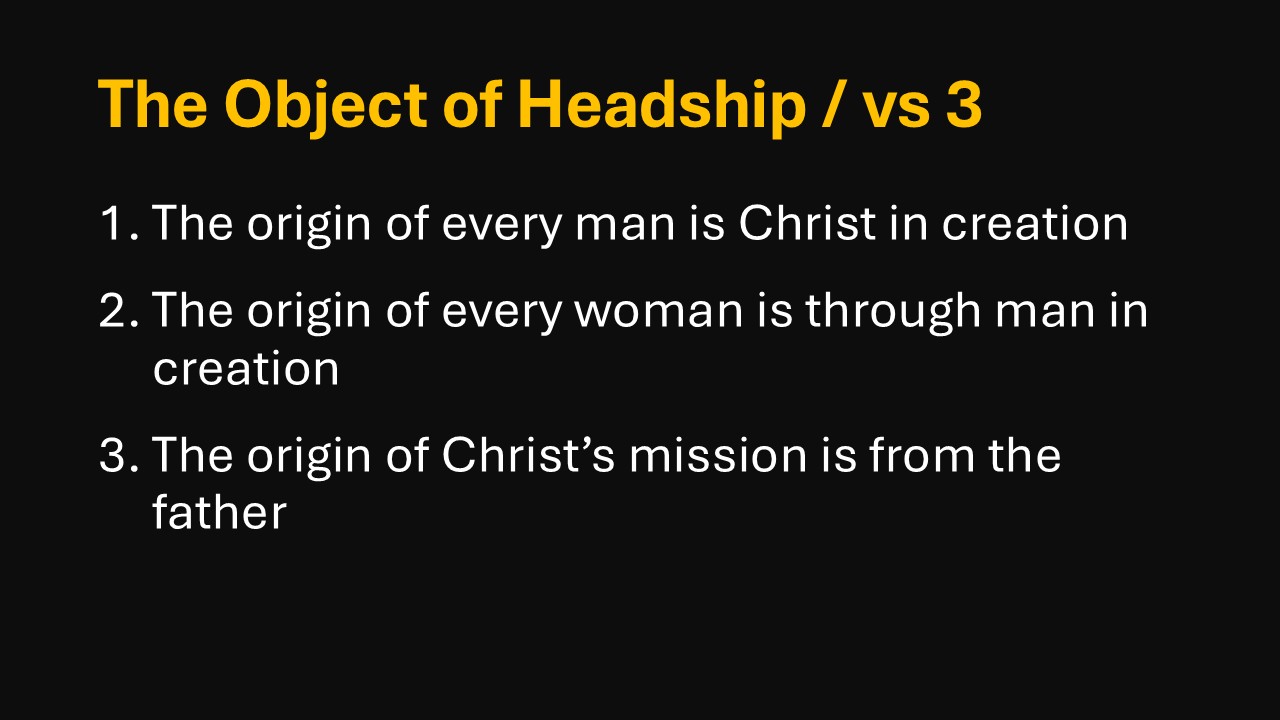
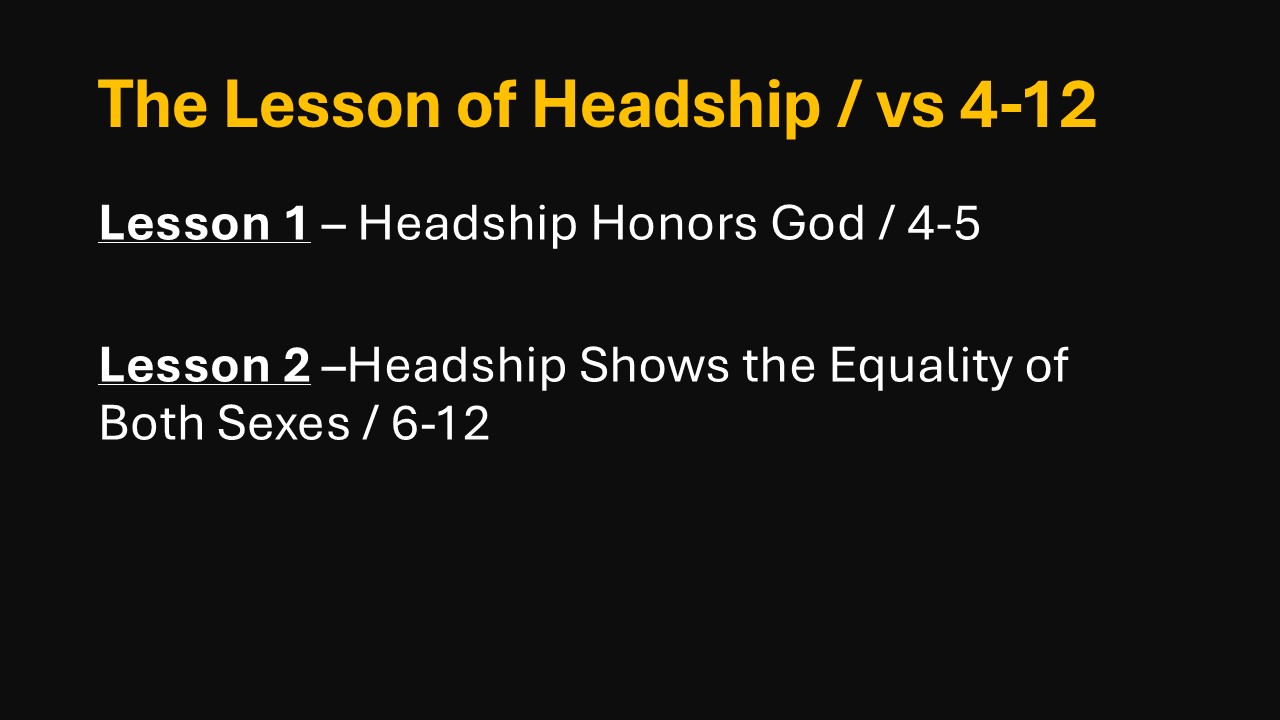
This Sunday we will take a dive into 1 Corinthians 11 and the headship principle. This passage and doctrine are often misunderstood and wrongly applied in Christendom. As we continue our search for the Male Identity, we will look at the object lesson of headship as it is taught in this passage and throughout the Bible. I invite you to come to church this Sunday, being willing to set aside whatever preconceived ideas you may have about this passage and doctrine. Then open your mind and heart to looking with me into scripture to see this amazing object lesson, then, by God’s grace look to be a living object lesson that reflects the creative order of God.

Today’s Scripture

March 15, 2026

As a Baptist preacher, I not only have been trained to interpret and preach the Bible literally, but I also preach that way by conviction. When you teach the Bible to be literally true there are bound to be things that will run counter to the culture we live in. In the recent years of my ministry, I cannot think of anything else that has been a tougher issue to teach from scripture than the role of men in the church, society as a whole and in the family. To espouse that a man is the “head” of a home is not a popular notion in the mainstream of our culture. There has been a huge cultural shift since the end of WWII for the demotion of men as the “head” of the family unit and to neutralize the sexes so there is no difference between men and women. Society emasculates men, makes them the butt of jokes, or calls them toxic as though they are a poison in the rest of culture. Mature men struggle with finding a safe identity not to mention the struggle boys and teenagers are facing with a myriad of voices telling them a hundred things they should be and should not be.

As a Preacher of the Gospel, I have had a great concern about that trend for the effect it is having on men, but also on women and in society as a whole. Preachers are not the only ones to have this concern. Scott Galloway, a professor of marketing at NYU’s Stern School of Business in NYC, has recently written a # 1 NYT bestselling book titled “Notes on Being a Man”. The introduction to the book sets the tone of the book:
“Boys and men are in crisis. Rarely has a cohort fallen further and faster than young men living in Western democracies. Boys are less likely to graduate from high school or college than girls. One in seven men reports having no friends, and men account for three of every four deaths of despair in America. Even worse, the lack of attention to these problems has created a vacuum filled by voices espousing misogyny, the demonization of others, and a toxic vision of masculinity. But this is not just a male issue: Women and children cannot flourish if men aren’t doing well. And as we know from spates of violence, there is nothing more dangerous than a lonely, broke young man.”

Scott Galloway is not a believer, but his book rings true with a biblical worldview about men and the need for the right kind of man in our society. Last year I was asked by a woman in our church if I would give some biblical teaching on the role of men and help answer some of the questions we face when we make a literal application of scripture to the role of men in the home, the church and in society. Starting this Sunday, I am doing a three-part sermon series titled “The MALE Identity”. The three messages are:

  1. Men: Created to Serve and Care
  2. Understanding Headship – it is not what you think.
  3. The Dominion of Men

You likely have caught on by now that I am not a typical Southern Baptist Preacher so I can guarantee you I will not approach this like most SBC preachers do. Because I think the role of men in our homes, churches and society is crucial for the health of those entities, what I want to do is challenge our thinking about this topic and by the Spirit of God with the Word of God pray that we will have a biblical view of the male identity. I am excited and nervous at the same time to preach these messages. I am excited because scripture has the answers to address this crisis in our society. I am nervous because I’m guessing that while I never try to do this on purpose, these messages are likely to be offensive to some of you either because you’ll think I’m too hard or I’m too soft on the subject. What I hope to be is biblical and edifying to you my sheep who are so susceptible to the devices of this evil world we live in.

March 8 – One Church Service

I don’t know about you, but I really do not like to wait. When I am driving in traffic, I’m usually assessing the traffic in front of me to see which lane will be the fastest getting through a stop light. I do the same thing at the grocery store checkout. If I am expecting an important delivery, I will check my doors several times before it comes. And we all know there are much more serious things people wait for; health results, the reconciliation of a relationship or for someone to genuinely say the words I love you. Waiting can often feel weighty.
This Sunday is our One Church Service, and I am between sermon series, so I felt God direct me to share this message from Psalm 130 where the Psalmist says, “I wait for the LORD, my soul waits.” Have you ever been, or are you in a place where you feel you are waiting for the Lord to do something in your life? It does not take long for our waiting to feel weighty, making us feel spent. On the journey of faith, the concept of movement is implied. When on a journey you move from one place to another. Sue and I have done a fair bit of hiking throughout our lives, and I can tell you any hike will include times of movement and times of waiting before the destination is reached. If movement were all we did on a hike we would miss the chance for hydration, nutrition, communication with others and the opportunity to see the beauty of the environment we are hiking. Times of waiting are needed both in the physical realm and in the spiritual realm.
Psalm 130 is an ascent Psalm the Israelites would sing on their way up to Jerusalem, from the depth of the valley to the heights of worshiping God. Join me this Sunday as this amazing text illuminates how The Weight of Waiting is something God wants to use in your journey of faith.