Memorial Day Message Recap

Greater Love Has No One Than This: Living Sacrificially Like Christ

Memorial Day offers us more than just a long weekend—it provides a profound opportunity to reflect on the ultimate sacrifice and what it means to live with sacrificial love. As we honor those who gave their lives for our freedom, we’re reminded of an even greater sacrifice that changed everything.

What Does It Mean That God Is Love?

The apostle John makes three powerful declarations about God’s nature throughout his writings. He tells us that God is light (righteous and true), God is spirit (not confined by the physical), and most importantly for our discussion today, God is love. This isn’t simply saying that God shows love or has love—it means He IS love itself.

Theologically, this means that any love that exists anywhere in the universe is sourced from God. When we see sacrificial love displayed by soldiers who die for their country, or by anyone who puts others before themselves, we’re witnessing a reflection of God’s very nature.

Why Did Jesus Die for Us?

What motivated Jesus to make the ultimate sacrifice? It wasn’t because we were worthy—Scripture is clear that we are unworthy in our sinfulness. It wasn’t because God had to—He doesn’t need anything from us. The motivation was simply love.

“‘Have this mind among yourselves, which is yours in Christ Jesus, who, though he was in the form of God, did not count equality with God a thing to be grasped, but emptied himself by taking the form of a servant, being born in the likeness of men. And being found in human form, he humbled himself by becoming obedient to the point of death, even death on a cross.'” – Philippians 2:5-8 (ESV)

Jesus left His place of comfort in heaven, assumed the role of humanity, and willingly paid the ultimate cost with no expectation of return from us. His death wasn’t just to be a good example or start a religious movement—it was for our redemption, restoring our relationship with the Father and giving us value.

How Should We Honor Those Who Died for Our Freedom?

“‘Pay to all what is owed to them: taxes to whom taxes are owed, revenue to whom revenue is owed, respect to whom respect is owed, honor to whom honor is owed.'” – Romans 13:7 (ESV)

Like Christ, the soldiers who died for our nation were motivated by love—love for family and country. They too left places of comfort, assumed roles they may not have chosen, willingly paid a cost, and had no expectations of adequate repayment for their sacrifice.

We honor them not just by remembering their names or flying flags, but by understanding that their sacrifice reflects the same divine characteristic we see in Christ—sacrificial love that puts others before self.

What Does It Mean to Live Sacrificially?

In our individualistic society, it’s easy to become focused on ourselves rather than others. We often ask, “What’s in it for me?” But Christ calls us to a different standard. He commands us to love one another as He has loved us—sacrificially.

“‘This is my commandment, that you love one another as I have loved you.'” – John 15:12 (ESV)

This goes beyond the golden rule of treating others as we want to be treated. Christ calls us to love others with the same sacrificial love He showed us, regardless of how we’ve been treated.

How Can We Love Others the Way Christ Loved Us?

The key to loving others sacrificially is understanding the depth of Christ’s love for us. When we truly grasp that Christ died for us while we were still sinners—while we were in opposition to God—we begin to understand the magnitude of His love.

“‘But God shows his love for us in that while we were still sinners, Christ died for us.'” – Romans 5:8 (ESV)

This understanding transforms us from orphans fending for ourselves to adopted children of God. “‘But to all who did receive him, who believed in his name, he gave the right to become children of God.'” – John 1:12 (ESV)

What Does Sacrificial Living Look Like Practically?

Like Christ, we can live sacrificially by:

Leaving Our Place of Comfort: Being willing to say there’s a higher purpose to life than just our comfort, wealth accumulation, or gaining admiration from others.

Assuming a Role: Becoming ambassadors of God’s love to others. Just as a political ambassador represents one person—the president—we represent Christ to the world.

Willingly Paying the Cost: God may call us to give up things we value, change career paths, or make sacrifices that open opportunities to serve Him in different ways.

Having No Expectations of Return: True Christlike love doesn’t expect something back. We serve because of love, not for what we might receive.

Where Can We Serve Sacrificially?

In Our Country: Through small acts of kindness, volunteering in communities, and advocating for justice and equality.

In Our Church: Serving in ministries, volunteering in areas of need, and working together with other believers for spiritual growth.

In Our Families: The most important form of “government” isn’t in Washington, D.C.—it’s in our homes. If we don’t learn to serve within our family units, we can’t expect to serve effectively anywhere else.

With Our Spouse: Instead of entering marriage expecting the other person to meet all our needs, we should focus on discovering ways to serve them sacrificially.

Life Application

This Memorial Day weekend, the greatest tribute you can give to those who died for our freedom—and the greatest way to honor Christ’s sacrifice—is to commit to living sacrificially in service to others. This means actively looking for ways to put others’ needs before your own, whether in your family, church, community, or nation.

Consider these questions as you reflect on this message:

  • In what specific ways can you leave your “place of comfort” this week to serve someone else?
  • How can you better serve your family members without expecting anything in return?
  • What opportunities exist in your church or community where you could volunteer your time and talents?
  • How does understanding the depth of Christ’s love for you motivate you to love others more sacrificially?

The call to sacrificial love isn’t just a nice idea—it’s the very essence of what it means to follow Christ and honor those who have given their lives for our freedom. When we live this way, we reflect God’s nature and provide the greatest possible tribute to both Christ’s sacrifice and the sacrifice of our fallen heroes.
Mother’s Day May 10th, 2026

Sunday is Mother’s Day and we will celebrate the mothers in our lives. For many of us motherhood has a positive connotation: you have a good mother or being a mother has been a major source of blessing for you. I also realize Mother’s Day does not have positive feelings for everyone attending our services on Sunday, and for that I am sorry. Mothers are given to us from God to be a source of blessing and the backbone of a healthy society. Whether motherhood evokes positive or negative feelings, society needs to recognize the value mothers are intended to have for all of us. 

Motherhood and womanhood in general have always been under some kind of attack, and our current times are not different. In the extreme feminist movement motherhood is viewed as an impediment for a woman in achieving her greatest success. The recent confusion of gender has been most acutely directed toward women. Biological men assuming the identity of a woman is a horrible affront to the importance of biological women in our society. The ancient text of Proverbs provides a counter cultural depiction of women and in particular, mothers.

The teaching and training of children is the critical function of the family unit for the propagation of a healthy society. History has shown us governments make for bad parents and don’t even come close to replicating the effectiveness of a husband and wife – a father and mother raising children together. In our text on Sunday, we will see the needed partnership of a father and mother sharing roles and responsibilities of shaping the next generation. Because it is Mother’s Day, we will emphasize the importance of mothers to care for and influence their children in a way that reflects God’s design for humans. Not only is God honored when we acknowledge the value of our mothers, humankind will prosper because mothers are the backbone to a healthy society. 

May 3, 2026

If there is a common affliction in our culture, it is the affliction of business. We all like to be busy and moments of solitude can be uncomfortable to the point we try to avoid them at all costs. There is constant activity in our brain and what we don’t deal with during our waking hours is often transferred to our subconsciousness during sleep. 

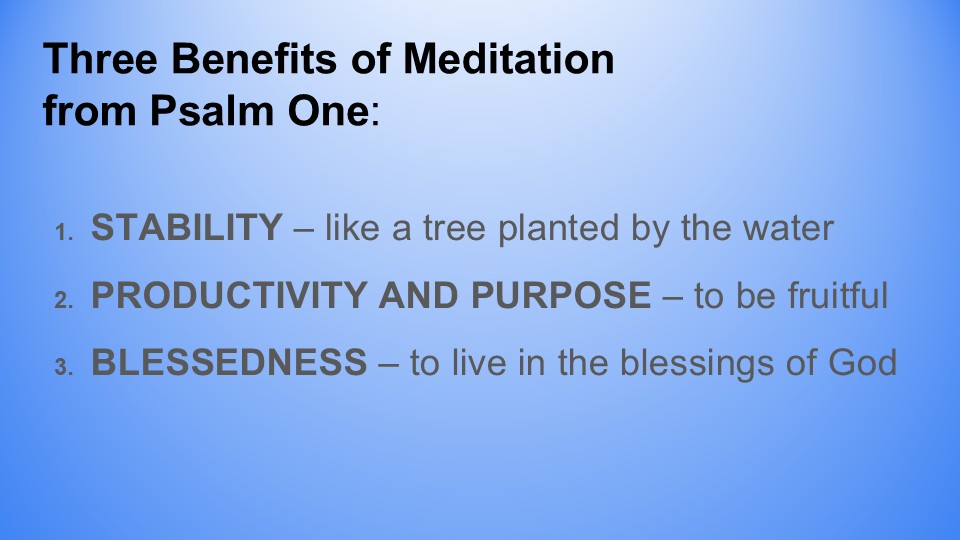
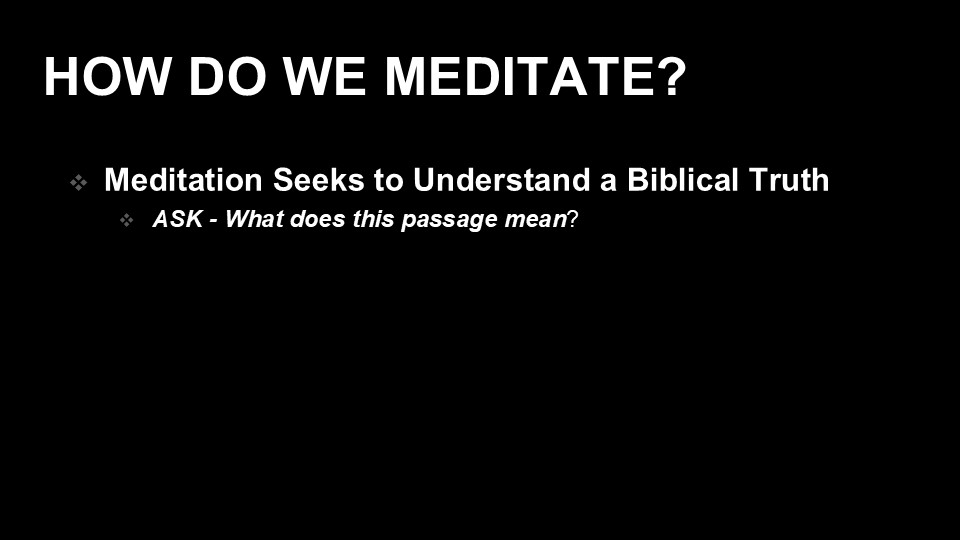
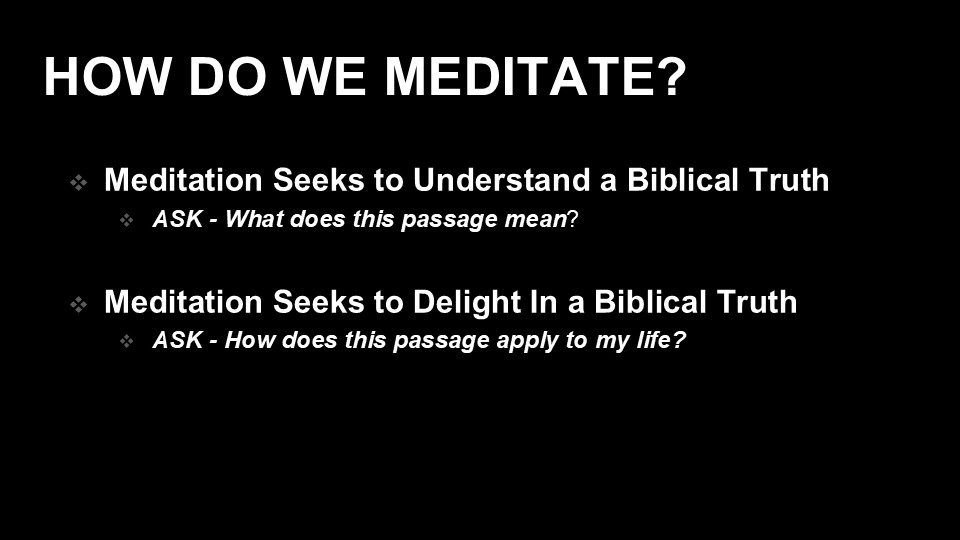
In our current series we are moving through the Lord’s Prayer and while it doesn’t explicitly tell us to slow down and listen to God, the context of Luke’s version is Jesus off in a quiet place praying when the disciples asked him to teach them to pray. The example of Jesus in prayer is to be quiet, slow down and listen to the father. This Sunday we will see that Christian meditation as an effective element of prayer. Christian meditation is vastly different from other forms of meditation as seen in the religion of yoga where meditation is the emptying of the mind. Christian meditation is replacing our troubling brain activity with the knowledge of God as revealed in His word. Christian meditation requires being informed with God’s Word first and as we mull over what we read, we can process our circumstances in a spiritually healthy way. Christian meditation requires some level of solitude to block out the noise of the world and to hear the voice of God. There is a place for praying as we move throughout the day, but there is a need to hit the pause button, slow down so we can listen to God in prayer. Prayer is a two-way conversation between us and God. Unfortunately, many times we dominate the conversation, not giving God a chance to speak and be heard. When you pray, slow down and listen to God.

Easter Sunday – April 5th, 2026

What is the most significant event that has happened during your lifetime? You could look at it from just your personal experience but maybe try to think of something that has happened on a bigger scale that has affected many people, including you. For me that would be the events of 911 on September 11th, 2001. I knew the moment I saw the second plane hit the World Trade Center our world would never be the same; and I was correct.
Throughout the course of human history there have been events, for the better or for the worse, that have changed the course of humanity. Time is the only way to know if the changes we are experiencing right now will be for the good or for the worse. However, there is one event that is tied to one person that stands out as the pivotal moment of all history. Easter and the resurrection of Jesus Christ is that event. The life of Jesus stands above every other life ever lived as the most important life. People the world over see this as the year 2026, which really means, “This is the year, In the Year of Our Lord, 2026.” The resurrection of Jesus is the most important and amazing event of all history: A person died and came back to life! If God can do that, God can do anything. Easter Changes Everything!
Some of the major events of history will not have a direct effect on our lives at this time. But the resurrection of Jesus still affects people’s lives today. We may think our lives are inconsequential in the grand scheme of things, but that is not how God sees it. Through the resurrection of Jesus God offers us that same amazing gift of resurrection: life after death. That is an event that affects our lives here and now as well as in the future. Easter does change everything. Join me this Sunday as we celebrate the resurrection of Jesus and how that one event changes everything.

March 27, 2026

The last two weeks we have looked at a biblical identity of manhood. We know that identity has been tarnished from the sinfulness of humanity that began in Genesis 3. We also know men today are searching for meaning and purpose in the false male identities Satan offers them as easy and poor substitutes for the identity God has called them to, a biblical identity that will provide true meaning and purpose to their lives. 

I Corinthians 16:13 challenges men with this statement: “Be watchful, stand firm in the faith, act like men, be strong.”  Act like men! What does that mean? The worship of female deities in ancient Corinth was a significant aspect of the city’s religious life, which was quite different from most Greco-Roman cities. One of the prominent goddesses was Aphrodite, the goddess of love, beauty, and fertility. Aphrodite was worshipped in various temples and shrines throughout Corinth, and the prominence of this female statue skewed the relationship between men and women. Like today, they tried to blur the genders, resulting in women seeking to be like men and men thinking they could be like women. As a result, men in turn shrunk to the shadows and everyone was hurting because of it. It is evident from even a casual reading of 1 Corinthians that this dynamic had penetrated the church, and Paul was writing to correct that problem. I suppose that, to address the issue, Paul could have cast a large blanket of blame on the government of the day or he could have rebuked the women, but he did not do that. Paul spoke directly to the men of the church to accept the responsibility God had given them by re-engaging the biblical male identity: “Act like men.” 

Calling men to act like men does nothing to diminish the significance and purpose of women. But what it does is challenges men to re-engage in their biblical identity, with the unique responsibility God has given to them. When men act like biblical men they will be fulfilled in their purpose, women will blossom, children will be nurtured and society will be a blessing to all the citizens of the community. Join me this Sunday as we conclude this series on The Male Identity. 

Choosing a New Bible

Do you have a good personal Bible?

When searching for a new Bible you will quickly realize there is a plethora of options. There are dozens of translations available, and then every translation has variations that focus on different segments of society. Not to mention the print size (the bigger the font the bigger the Bible), the binding (paperback to Goatskin) and the notes that can come with them, often written by an influential Christian leader. If this churchwide focus on the Bible has caused you to think about getting a new Bible, may I offer some suggestions.

  1. Translation: While there are many good translations available, may I offer two good ones to choose from that are reliable and readable in contemporary English: the ESV – The English Standard Version and the NIV – The New International Version. Click Here for more information about translations.
  2. Additional Notes: After you’ve decided on the translation you may want to consider a Bible with additional notes. These are often called Study Bibles and offer explanations of things in the Bible that are difficult to understand in our present day. They usually will have introductory pages to each book of the Bible, character studies, maps, word definitions and theological commentary. This is largely a personal preference but considering the person or group that compiled the notes is important. The Publisher of the Bible is something to consider. Crossway, Thomas Nelson, Tyndale, Lifeway, and Zondervan are all good publishers. Caution: a large print Bible with notes can be very large and heavy. 
  3. The Binding: This is where cost will come to play. As with all books, a paperback version will be the most cost effective, but they will wear out the quickest. If cost is a factor for you, a hard cover Bible usually will last longer than a paperback and not cost much more. A leather-bound Bible is the best all around for looks, feel, ease of use and durability. A word of caution: not all leather Bibles are equal. A bonded leather is not much better than a hard cover Bible and will wear out quickly. If you want a leather Bible, make sure it is “Genuine Leather” as that will check all the boxes of a good leather Bible.  
  4. Personal Preferences: After you have decided on the three above, look for the ones that meet your preferences: color, font size, single column or two. The Bible you choose should be personal to you so take the time to choose wisely and enjoy it for years to come. In my adult life I am now on only my third Bible and every time I have gotten a new one it has been a major decision for me. 

Online Digital BiblesYou Version is the most popular one and is what we use for our Sunday service scripture reading. This app has lots of capabilities to help you study the Bible well. 

If you do find a store that sells Bibles, they may not have much to choose from. Here is a link to an online Christian bookstore where you can shop for a new Bible. They have an extensive inventory and are designed to help you find the best Bible. I am also available to offer advice if you need some extra guidance in choosing a Bible. Helping people find a good Bible is one of the things I love to do as a Pastor.

YBIC – 

Pastor Andrew Matthews