The Bible: The Divinely Inspired Word of God, comprising 66 books that were written by 40 human authors over almost 1500 years of time, covering all of human history. The Bible was written to various different cultures, not to mention the diverse geo-political situations on the earth. It would be natural to think the Bible is a fragmented book that records specific eras of history, throwing in some philosophy to make it interesting. To the contrary, the Bible is a unified book that tells one marvelous story. You ask how that can be? We need to remember that the divine author is also the divine sovereign who rules over all of human history to work His divine purposes for all that He has created. The Bible conveys that one story of History that is His-story.
To help us see this on Sunday I want to take us back to High School literature class, using the parts of a good story, I want us to see how the Bible tells a unified story. A story that is true and continues to point people to the message of God’s power, righteousness, love, mercy and grace. Join me this Sunday for the Big Picture Look at what the Bible is telling us about God, the world we live in and ourselves.
On Sunday night I didn’t get the rest I needed after a long day. You would think I would have rested extremely well considering I had been up since 5 am and didn’t really stop until 14 hours later, about an hour before I went to bed Sunday night. But I didn’t rest well at all. Why was that? I know why . . . I had spent the entire day, going from one task to another, multitasking just to stay on top of what I needed to do to get through the busiest single day of the year for me. When it came time for me to shut down for the night, I couldn’t find the rest I needed. Thankfully, I have slept extremely well the rest of the week.
Our text this Sunday, Hebrews 3 & 4 talks about the need for rest; spiritual rest. Spiritual rest comes when the believer stops their self-efforts of righteousness and rests in the finished work of Christ. The writer of Hebrews issues a warning that if we fail to hear and obey the Word of God, we will miss this rest. In place of this spiritual rest, people strive in their own self effort, trying to gain for themselves what only God can provide for them. Self-effort is part of our fallen condition and is very hard to completely abandon. What can be done to find a better rest?
Hebrews 4:12-16 provides the path to finding true and lasting rest. It begins with letting the Word of God do spiritual surgery on us that allows God to perform the needed healing. Join me this Sunday to see the powerful effect reading the Word of God can have on your life, and the rest you will find.
Reading and understanding the Bible does not come naturally to any of us. There are several factors working against us: The Devil doesn’t want you reading the Bible, so that means there is a spiritual opposition to reading and understanding the Bible. The Bible was written between 2000 – 3500 years ago, in a different language, referencing different cultural nuances that are unfamiliar to us. Let’s face facts, the Bible is really old. Last week we learned that the Bible has 40 different human authors with different writing styles. The Bible has many different literary styles, some of which we would never read in any other aspect of our life. The apocalyptic writings are very hard, but even the Gospels can be hard if we don’t understand that the Gospel is a particular literary genre from that time period that we don’t have today. I could go on . . . but you get the idea.
If you can relate, don’t be discouraged. I have a message of hope for you this Sunday: that you can read and understand the Bible. This week our entire church will be introduced to a method of reading the Bible that will help anyone better understand what they are reading in the Bible. It’s called the 7 Arrows of Bible Reading. The 7 Arrows prompts 7 questions to ask as you read a passage of scripture. For my message this week I will preach from Philippians 1:1-11, using the 7 Arrows method to unlock the meaning of the passage. Then, in the Community Group meetings, you will receive some teaching and coaching on how to do this yourself.
I’m going to guess that most of you have never had anyone teach you a simple way to effectively read the Bible. This Sunday, you will have an opportunity to change that. We want to help you be able to Read and Understand the Bible on your own, experiencing the life transforming power of God’s Word.
When searching for a new Bible you will quickly realize there is a plethora of options. There are dozens of translations available, and then every translation has variations that focus on different segments of society. Not to mention the print size (the bigger the font the bigger the Bible), the binding (paperback to Goatskin) and the notes that can come with them, often written by an influential Christian leader. If this churchwide focus on the Bible has caused you to think about getting a new Bible, may I offer some suggestions.
Translation: While there are many good translations available, may I offer two good ones to choose from that are reliable and readable in contemporary English: the ESV – The English Standard Version and the NIV – The New International Version. Click Here for more information about translations.
Additional Notes: After you’ve decided on the translation you may want to consider a Bible with additional notes. These are often called Study Bibles and offer explanations of things in the Bible that are difficult to understand in our present day. They usually will have introductory pages to each book of the Bible, character studies, maps, word definitions and theological commentary. This is largely a personal preference but considering the person or group that compiled the notes is important. The Publisher of the Bible is something to consider. Crossway, Thomas Nelson, Tyndale, Lifeway, and Zondervan are all good publishers. Caution: a large print Bible with notes can be very large and heavy.
The Binding: This is where cost will come to play. As with all books, a paperback version will be the most cost effective, but they will wear out the quickest. If cost is a factor for you, a hard cover Bible usually will last longer than a paperback and not cost much more. A leather-bound Bible is the best all around for looks, feel, ease of use and durability. A word of caution: not all leather Bibles are equal. A bonded leather is not much better than a hard cover Bible and will wear out quickly. If you want a leather Bible, make sure it is “Genuine Leather” as that will check all the boxes of a good leather Bible.
Personal Preferences: After you have decided on the three above, look for the ones that meet your preferences: color, font size, single column or two. The Bible you choose should be personal to you so take the time to choose wisely and enjoy it for years to come. In my adult life I am now on only my third Bible and every time I have gotten a new one it has been a major decision for me.
Online Digital Bibles – You Version is the most popular one and is what we use for our Sunday service scripture reading. This app has lots of capabilities to help you study the Bible well.
If you do find a store that sells Bibles, they may not have much to choose from. Here is a link to an online Christian bookstore where you can shop for a new Bible. They have an extensive inventory and are designed to help you find the best Bible. I am also available to offer advice if you need some extra guidance in choosing a Bible. Helping people find a good Bible is one of the things I love to do as a Pastor.
There once was a time when most of the people in society accepted the Bible as not only God’s Word, but as trustworthy. The Bible was considered to be the book of truth and should not be questioned. Postmodernism changed all that. We now live in a time of skepticism about a great many aspects of society and especially about the Bible. Liberalism has crept into some of our main line Christian denominations, changing their view of the Bible from being God’s Word to just containing or having the Word of God. The implication of those statements is that the Bible is partly God’s Word, but other parts are not. Critical scholarship has also made unfounded accusations that the Bible has been edited over a period of centuries to better fit the agenda of a certain group of people. These points of criticism, along with others, have left people wondering if they can really trust the Bible. Is the Bible Reliable?
This Sunday, as well as in our Community Group studies, we will seek to answer that question. To have the full answer you will have to join us for church this Sunday, but the short answer to that question is YES, you can 100% trust your Bibles. This will be a very different kind of message for me to preach. I usually share an expository message from one primary text of Scripture. This week, I want to trace the history of how we got the Bible as we have it today. As we consider the way the Bible has carefully been handed down from generation to generation, it will give you confidence in the reliability of The BOOK.
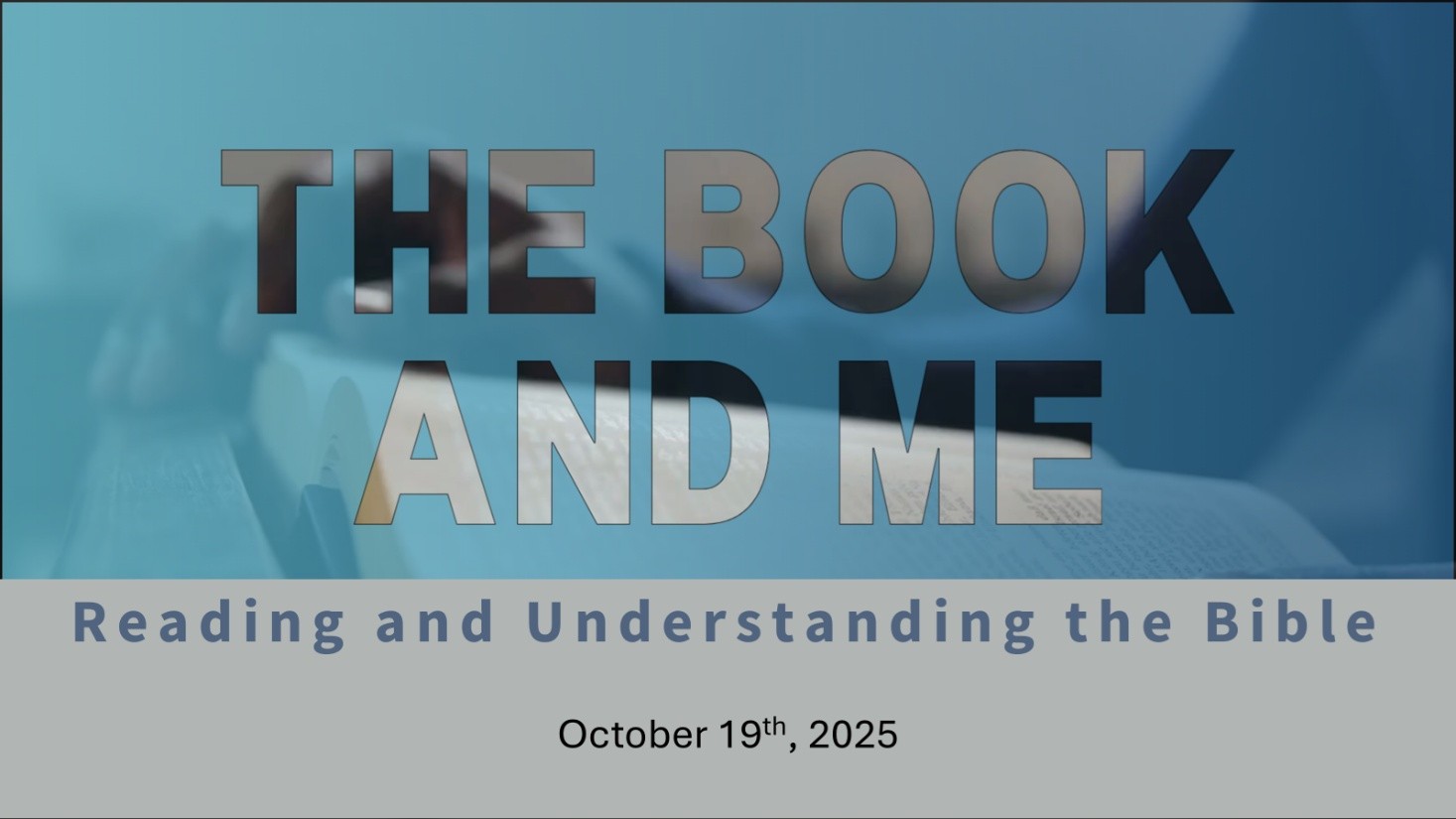
Sunday we start a new Churchwide focus on the role of Scripture in the believer’s life: The BOOK & Me. I am excited to share this series with you simply because I love the Word of God! The Bible is the greatest book ever written and is the bestselling book in human history. The Bible has the power to transform lives, entire societies, and I know has transformed me. From a literary perspective, the Bible is unparalleled in the beauty with which it is written and historically, the Bible provides a truthful insight into humanity that no other writing can.
Why does the Bible need to hold such a high place for us? Because it is no ordinary book. The Bible is the very Word of God. Every word of that last sentence is important to understand if we are to grasp the impact of the Bible on our lives. The operative word in that sentence is the verb “Is.” The Bible does not simply contain the Word of God, or have the Word of God, or become the Word of God. No – the Bible is the very Word of God. And because the Bible is the Word of God, we must assume that it holds authority over our lives and when we live under the instruction found in the Word of God, we will discover the blessing of God.
I’m also excited about this series because what I will preach on Sundays will be reinforced in the 12 Community Groups meetings throughout the week as they join in a study that corresponds to my messages. We currently have around 120 adults in those various community groups and there is room for more to join. If you are not already in a community group, I invite you to join one, even if it’s only for this 6-week series, by completing the BOOK & Me commitment card. We will help you find a group that is convenient for you to join.
THIS SUNDAY – Scripture Alone
During the protestant reformation there were five simple statements, the 5 Solas, which were foundational to the reform brought to the church. Sola simply means “Alone.” The first is Scripture Alone – Sola Scriptura. What that statement corrected in the church is that the Holy Scriptures, the Bible, are the complete revelation of God: it is God’s Word. The 66 books that comprise our Bible are the complete written revelation of God and should not be added to or subtracted from. That makes the Bible a necessary book for every believer to grow in their relationship with God. Join me this Sunday as we start this exciting series on the Bible, the most amazing book in all of human history.















 andymatt723