March 2, 2025

Sunday we start a new sermon series from John 18 & 19: Passion – It Wasn’t the Nails. This series will take us all the way to Easter week covering the events of Jesus’ arrest, trial, crucifixion and death. Over the last year I have been preaching through the Gospel of John and this series, together with the few weeks following Easter, will conclude our journey through that book.
This Sunday as we look at the arrest of Jesus in John 18, you will see an unusual confidence that Jesus has in the midst of a very stressful situation; his arrest and impending execution. A term that is used to describe the events surrounding Jesus’ crucifixion is “The Passion of the Christ.” Mel Gibson’s movie about the crucifixion has that very name. Why is this called “The Passion of the Christ?” The simple answer is because this is the very thing Jesus came to earth to do, and now that it has finally arrived, Jesus enters into it with great passion as he seeks to fulfill the will of the Father and mission he came for.
From a human perspective it would appear that the events of John 18 & 19 caught God and Jesus off guard. That they were surprised and ambushed by the enemy. That when Jesus was crucified, the nails and the hammer that drove them into his flesh were what put him and kept him on the cross. In this series we will see it wasn’t the nails that kept him there – it was his passion; a passion that is fueled by the love of God for all sinners throughout human history. Join me for this new sermon series as it conveyed the exciting conclusion to the Gospel of John.

February 23, 2025

This Sunday we will wrap up our six-week Kingdom Economics sermon series by considering the returns good stewardship brings. I remind you that stewardship is not just what we do with our financial resources, it is the stewardship of our lives that includes money as well as our time, our abilities and the relationships we invest in. As we conclude this series, I want you to see what the return for your investment is. The return is not seen in a growing bank account either for the individual or for the church, but the number of lives that are reached with the gospel of Jesus Christ.
Every other philosophy about how to invest the resources of your life will always be based on how much of a return will come personally to you. That is not how Kingdom Economics works. Biblical stewardship is for the growth of God’s Kingdom through the number of lives reached with the gospel of Jesus Christ. In essence, Kingdom Economics calls us to invest for the benefit of others. However, there is a side story to Kingdom Economics we all need to see and consider. The greatest joy and blessing in life does not come from using our resources for our benefit and pleasure. The greatest joy for the believer comes from seeing what God will do to transform lives for eternity when we practice biblical stewardship.
This week I will invite you to make a commitment to practice biblical stewardship as taught throughout Kingdom Economics. Click the link below or use the paper forms at the Welcome Table after service to make your response.

February 16th, 2025

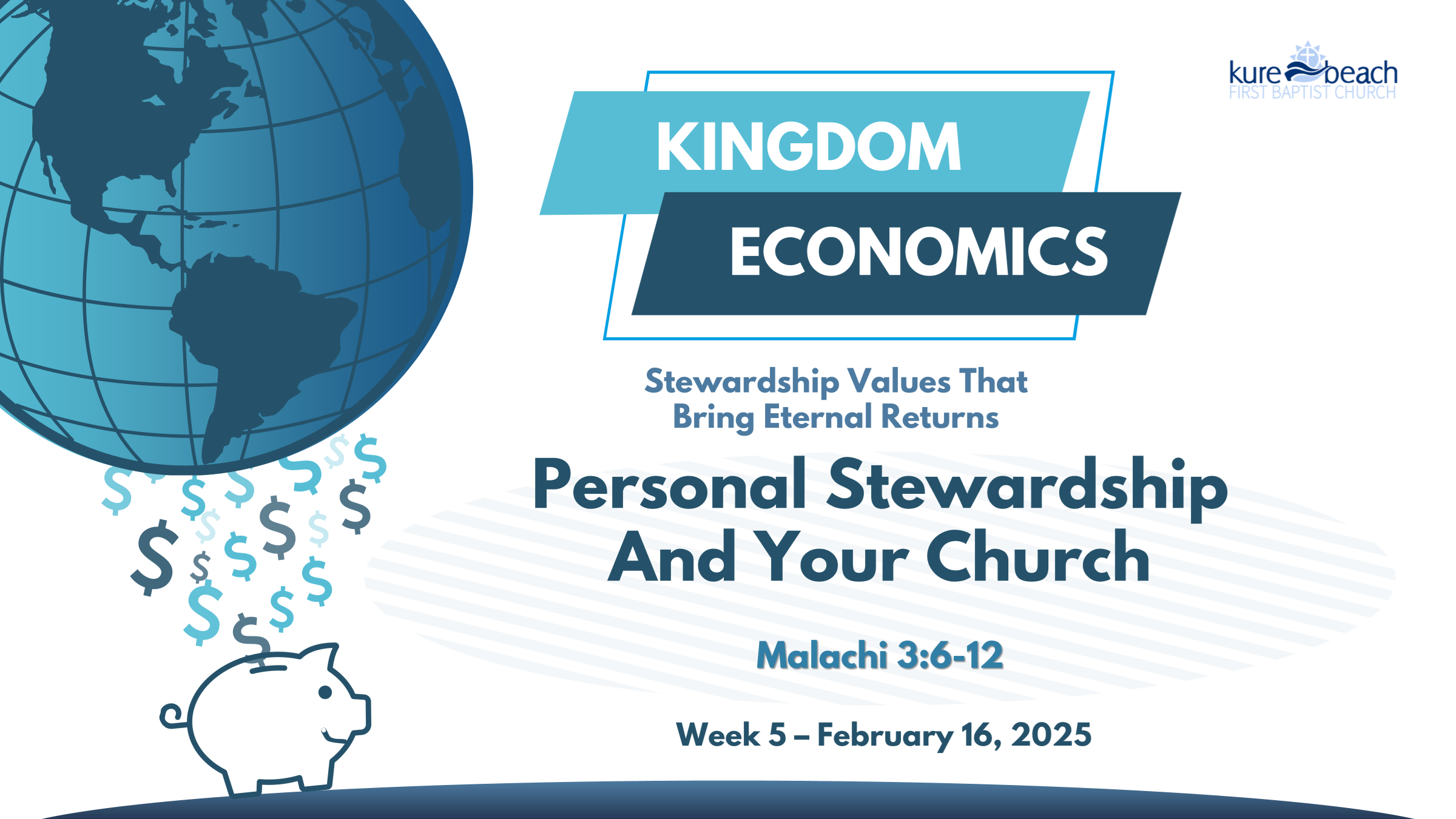
To this point in our sermon series, Kingdom Economics, we have considered some general stewardship principles from scripture. This Sunday we are going to consider stewardship on a more personal level as it relates to the local church.
While there are many different denominations in Christendom who deal with finances very differently from each other, we are a Baptist church that functions in the congregational system of church operations. The ecclesiology (big word for how a church operates) of congregational churches is under the Lordship of Christ and through the activity of the church body. Our church operates as an autonomous, self-governing entity. The church members, led by the Holy Spirit, are the decision makers of our church, and when it comes to finances, we are responsible for the income and expenses of the church. The church members decide what the church budget should be to operate the church and therefore, it is the congregation of the church that we depend on to give generously so we can reach our budget goals for the ministry to be fulfilled. There are no outside streams of income to the church. This Sunday, look around at the people attending the same service as you and understand that it is by the generosity of those people, together with you, that our ministry is funded.
Sunday, I intend to share some of the ministry we can do because people like you, under the Lordship of Christ, give proportionally and systematically to this church. Through the offering and the acts of service by people in our church we are fulfilling an Act 1:8 strategy for mission: local to global. Most of our budget goes to the ministry we have right here on Pleasure Island and the surrounding area. We also share in ministry across our state and in missions all over our nation as we support the North American Mission Board. In obedience to Scripture, we are also engaged in supporting missions to the other nations of the world through the International Mission Board. At this time, we are especially focused on the Bengali people around the world, in south Asia and with the help of Russell Abraham in places like New York City. That kind of mission can only be accomplished with the generous financial support of the people that make up the congregation of this congregational church. Join me this Sunday as we lay a biblical foundation for our personal stewardship and the local church.

February 2, 2025

For most people, generosity is not a natural inclination. We have inherited that attitude because part of our fallen human nature strives to live independent of God’s grace and instinctively assume a defensive posture when it comes to our survival. Generosity, with no expectation of repayment, works against being fully prepared for the worst case scenario. We wonder “how much will be enough?” If I give something away, will that mean that I will miss out on something I may need later on in life? This attitude is rooted in a basic human independence that has missed the supernatural way in which God provides for all our needs: GRACE. In Charles Dickens “A Christmas Carol”, Scrooge is a perfect example of how that attitude can lead to a very dark place. Scrooge followed that line of thinking to the point of total isolation for society, deep seeded anger and a hopeless future. It is also a dangerous attitude for a believer to have because it will stifle the generosity God calls us to exercise in our stewardship.

Why is it that generosity is not a problem for some people and yet for others, the thought of being generous brings on a life crisis? What is the factor that moves people to be generous? There is one word that answers those questions: GRACE! Generous people operate in the knowledge and belief that they have received the grace of God, which frees them to be generous with what God has given them. Sunday we are going to look at the example of the early church in Acts 4 where people began to practice generosity with the church and to the community. Like Scrooge, they experienced grace in a profound way and as a result their attitude about possessions was changed. Where before grace they were tight fisted with their money; they became radically generous. Join me Sunday morning as we consider this formula of Kingdom Economics: Stewardship + GRACE = Generosity.

January 26th, 2025

Last Sunday was the start to Kingdom Economics; a six-week sermon series on biblical stewardship. When I use the word “economics” I’m not referring to financial economics but am using that word to describe the values, principles and systems that we live by as stewards in the kingdom of God. Stewardship in God’s kingdom is not relegated to one specific area of life but permeates every aspect of a disciple’s life. Sunday we will consider “The Stewardship of Life.” If we believe God owns everything (last week’s teaching) and all we have is from God, it is only logical to conclude our very lives belong to God. And if our lives belong to God we need to be good stewards of all that we do with our lives. From Matthew 25, the parable of the talents, we see principles that a good steward will follow as they manage the resources from the master. From 1 Corinthians 4 we know that a steward is to be found faithful. Matthew 25 answers the question, “What does it mean to be a faithful steward?” Join me Sunday as we consider stewardship as a way of life that encompasses all we are and do.

As part of this series, I’m inviting everyone who considers themselves to be part of Kure Beach FBC to make a commitment for this sermon series. Here is a link to that commitment card or you can fill out a paper version at service this Sunday. One of the commitments is to be in attendance for or to watch all 6 messages in this series. Click Here to watch last week’s teaching.

January 5th, 2024

It is difficult, even for the best of us, to remember all the things we need to remember. It seems that the more things we are engaged with, the more there is to remember, increasing the chances of forgetting something. That is why most of us use devices of some kind to help us remember the important things. We have a list of important contacts with a phone number. We either use the same password for all our computer / smart phone things or we use some kind of a password storage system in the event we forget one. We use calendars to keep track of appointments, obligations and other important events like birthdays. Most of us have some form of a To-Do-List so we are productive with our time. If something is important it is worth remembering so we make an effort to find a way to remember.
There is one thing Satan wants the Christian to forget: that we are forgiven. Does that ever happen to you? You know you have made a commitment to Christ at some point in the past and believe Christ has forgiven you of your sins; past, present and future. However, there are times that the Devil tries to convince you that you are not really forgiven, or we fall into living as though we are not forgiven by God’s grace; that we have to work to make our own atonement. God wants the Christian to remember you are freely forgiven by His grace through Jesus Christ. God has given us something to help us remember we are forgiven: Communion. Communion is not just an empty tradition or ceremony. I actually don’t think communion was ceremonial in its original use. Rather, it was relational and part of a normal gathering of people. Join me this Sunday as we celebrate the communion we have with God, because we are forgiven.

December 29th, 2024

I hope you have had a wonderful celebration of Christ’s Birth! Merry Christmas!

This week we are going to turn our attention to Matthew 2 and the account of the Magi’s visit to the Holy Family. There is a lot going on in this chapter, but I want to focus our attention on the concept of wisdom as it’s lived out in this passage. Wisdom is defined as “the ability to use your knowledge and experience to make good decisions and judgments.” In our text we will see one man, King Herod, makes a bad decision and judgment because he refused to accept the knowledge he had. Herod failed to apply wisdom to his knowledge and experience. However, the Magi from the east had the same knowledge as Herod, but acted with wisdom based on what they knew. The results were drastically different between Herod and the Magi – that’s why we call them “Wisemen.”
All of mankind faces a similar situation as Herod and the Magi. We are blessed to live in an age of knowledge unlike anything human history has known. Together with knowledge people can have experiences previous generations could not even imagine. As with the characters in Matthew 2, all knowledge is used through the filter or lens of an individual’s own biases and presuppositions. People can filter the knowledge of the universe through their own presupposition, a presupposition that often elevates man’s place in the universe and at the same time diminishes God’s. The outcome from Sunday’s passage is one of either worship of the one true king, or embracing a culture that leads to death. Will you follow the path of the Magi and become a wiseman (or wisewoman) by considering the natural revelation through the knowledge and experience of a supernatural God.

December 22, 2024

Sunday is Christmas Sunday! As we move through the themes of Advent, this week we focus on the love of God we receive at Advent. John 3:16 is the most well known verse in all scripture and there we read that “God so loved the world that he gave His one and only Son.” The Advent of Christ must be viewed as a gift, motivated by the pure love of God for us.
At Christmas we give gifts to various people in our lives, from close family members to people we barely know. The gifts we enjoy giving the most are ones we give motivated out of love for the person we give the gift to. But even then we may feel anxiety wondering if it is a good gift that they will like and enjoy. Sunday we will see that the gift of love at Advent is the right gift at the right time, a gift money cannot buy and a gift that keeps on giving. Join me as we celebrate God’s great gift of love to us in His Son, Jesus Christ.

December 8th, 2024

Sunday starts the second week of advent and we will focus our attention on the peace Christ brings to us. The word peace in the Hebrew Scriptures speaks of a person’s wholeness, completeness, unity and harmony. As defined this way, peace is an undeniable need in our society. It is as though there is a force at play which seeks to divide, fragment and disrupt our human existence. Can you relate? Do you feel torn and pulled in different directions? Is your life lacking harmony that leaves you feeling used and worn out? The Heart of Christmas Brings Peace.

This Sunday we will look into the Old Testament to see when peace was first lost for mankind, what were the effects of losing that peace and how Advent restores peace. Understanding the back story to the loss of our peace will frame for us the work of Christ in bringing peace to us. Have you ever wondered why it was the shepherds God first announced the Advent of Christ into the world? Shepherds were considered unclean and out of the fellowship of the spiritual elite of the day. They would have been the last people most would have thought for that kind of announcement to be made. But that is just the point of the gospel; the Advent of Christ is Good News for everyone, including those that are on the outskirts of society. Join me this Sunday as we see that The Heart of Christmas Brings Peace.