February 2, 2025

For most people, generosity is not a natural inclination. We have inherited that attitude because part of our fallen human nature strives to live independent of God’s grace and instinctively assume a defensive posture when it comes to our survival. Generosity, with no expectation of repayment, works against being fully prepared for the worst case scenario. We wonder “how much will be enough?” If I give something away, will that mean that I will miss out on something I may need later on in life? This attitude is rooted in a basic human independence that has missed the supernatural way in which God provides for all our needs: GRACE. In Charles Dickens “A Christmas Carol”, Scrooge is a perfect example of how that attitude can lead to a very dark place. Scrooge followed that line of thinking to the point of total isolation for society, deep seeded anger and a hopeless future. It is also a dangerous attitude for a believer to have because it will stifle the generosity God calls us to exercise in our stewardship.

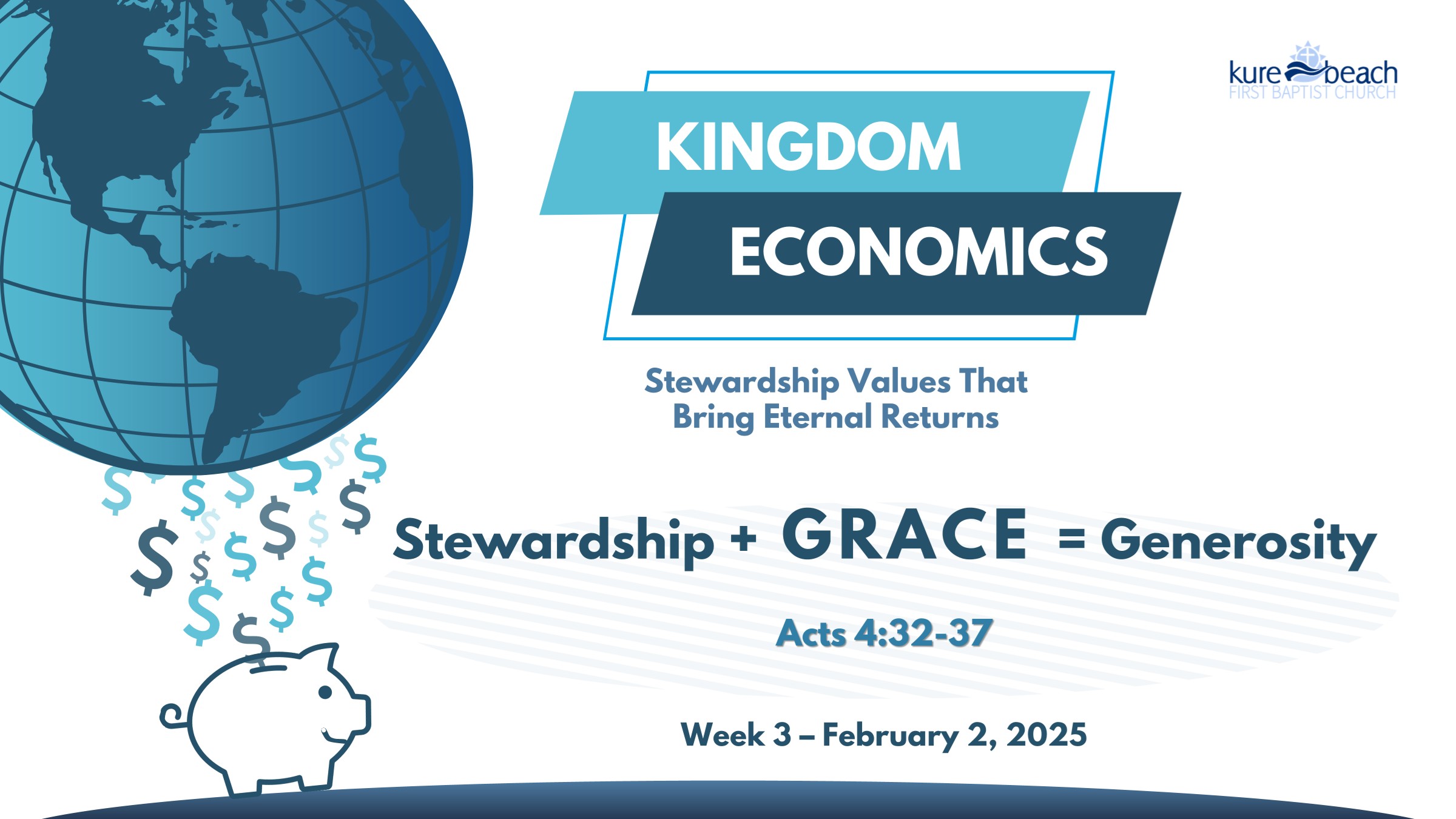
Why is it that generosity is not a problem for some people and yet for others, the thought of being generous brings on a life crisis? What is the factor that moves people to be generous? There is one word that answers those questions: GRACE! Generous people operate in the knowledge and belief that they have received the grace of God, which frees them to be generous with what God has given them. Sunday we are going to look at the example of the early church in Acts 4 where people began to practice generosity with the church and to the community. Like Scrooge, they experienced grace in a profound way and as a result their attitude about possessions was changed. Where before grace they were tight fisted with their money; they became radically generous. Join me Sunday morning as we consider this formula of Kingdom Economics: Stewardship + GRACE = Generosity.
January 26th, 2025

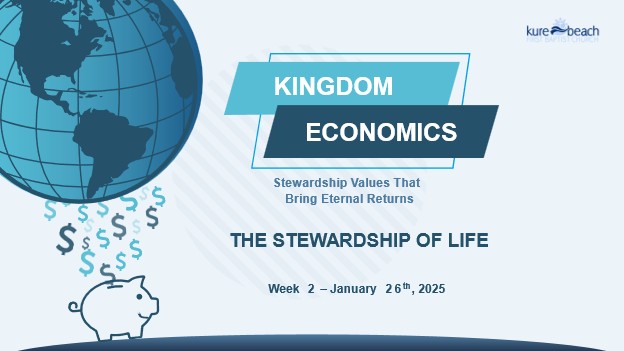
Last Sunday was the start to Kingdom Economics; a six-week sermon series on biblical stewardship. When I use the word “economics” I’m not referring to financial economics but am using that word to describe the values, principles and systems that we live by as stewards in the kingdom of God. Stewardship in God’s kingdom is not relegated to one specific area of life but permeates every aspect of a disciple’s life. Sunday we will consider “The Stewardship of Life.” If we believe God owns everything (last week’s teaching) and all we have is from God, it is only logical to conclude our very lives belong to God. And if our lives belong to God we need to be good stewards of all that we do with our lives. From Matthew 25, the parable of the talents, we see principles that a good steward will follow as they manage the resources from the master. From 1 Corinthians 4 we know that a steward is to be found faithful. Matthew 25 answers the question, “What does it mean to be a faithful steward?” Join me Sunday as we consider stewardship as a way of life that encompasses all we are and do.

As part of this series, I’m inviting everyone who considers themselves to be part of Kure Beach FBC to make a commitment for this sermon series. Here is a link to that commitment card or you can fill out a paper version at service this Sunday. One of the commitments is to be in attendance for or to watch all 6 messages in this series. Click Here to watch last week’s teaching.

January 19th, 2025

Sunday we start a new sermon series titled “Kingdom Economics.” I’ve been the pastor of this church for almost 3½ years and I have yet to preach a message on money or giving. The Lord has provided and our congregation has been generous in their giving to the ministry of this church, for which I am very thankful. So why am I doing a stewardship series now? First of all, because God has a lot to say about our money and what we do with it. I would be neglecting a large part of the Bible if I avoided teaching on this topic. Secondly, this is a stewardship series, which includes more than just our personal finances. Stewardship calls us to consider the totality of our lives as it relates to serving God and advancing His kingdom. I chose the title Kingdom Economics because the word “economics” refers to a social science that studies how people use resources, produce goods and services, and make decisions. In this series we will consider much more than just our money.

As we start this new series, I’m inviting the entire congregation to start this series by making a commitment: 1) to be in attendance for or watch all the messages in this series; 2) to do a 7 day reading plan; 3) to have a household conversation about stewardship in your home; and 4) share something you are thankful for that I could share in one of my messages. Use this link to make your commitment.

To start the series, this week I am preaching a message titled The Owner – Manager Relationship. The first step in good, Christian stewardship is to understand what a steward is. A steward owns nothing, but manages the resources of the owner that he works for. In Kingdom Economics, God owns everything, and we manage those resources. Once we have the ownership matter settled, the steward piece becomes easier to grasp. Join me this Sunday as we start this new series on stewardship.

January 12, 2025

What makes something sacred? Why do Christians think of human life as sacred? The word “sacred” means to be set apart from everything else for a specific purpose. From all that God created in the entire universe we believe that human beings are set apart from everything else, for a unique purpose.
Prior to the flood we read that “the earth was corrupt in God’s sight and was full of violence.” The word “violence” used in the opening chapters of Genesis in contrast to God’s creativeness. Man, in his sinfulness, would attempt to de-create what God had created, particularly against other humans. Why would this happen? Because man is created in the image of God and thus because the prime target of de-creation.
Thousands of years later we are still dealing with the same problem. De-creation in a growing culture of death. This Sunday we will look at the primary doctrine of humans as the image bearers of God.

January 5th, 2024

It is difficult, even for the best of us, to remember all the things we need to remember. It seems that the more things we are engaged with, the more there is to remember, increasing the chances of forgetting something. That is why most of us use devices of some kind to help us remember the important things. We have a list of important contacts with a phone number. We either use the same password for all our computer / smart phone things or we use some kind of a password storage system in the event we forget one. We use calendars to keep track of appointments, obligations and other important events like birthdays. Most of us have some form of a To-Do-List so we are productive with our time. If something is important it is worth remembering so we make an effort to find a way to remember.
There is one thing Satan wants the Christian to forget: that we are forgiven. Does that ever happen to you? You know you have made a commitment to Christ at some point in the past and believe Christ has forgiven you of your sins; past, present and future. However, there are times that the Devil tries to convince you that you are not really forgiven, or we fall into living as though we are not forgiven by God’s grace; that we have to work to make our own atonement. God wants the Christian to remember you are freely forgiven by His grace through Jesus Christ. God has given us something to help us remember we are forgiven: Communion. Communion is not just an empty tradition or ceremony. I actually don’t think communion was ceremonial in its original use. Rather, it was relational and part of a normal gathering of people. Join me this Sunday as we celebrate the communion we have with God, because we are forgiven.