Sunday is the first Sunday of Advent and with it we start our new Advent sermon series “The Promise: Our Savior has Come.” People make promises all the time, but do we always keep them? The promises God makes are different because he always keeps all of His promises. Of all the promises God has made they are met in the one promise of a savior that is fulfilled in the advent of Jesus Christ. During December we will celebrate this life-changing promise.
This Sunday we start with a message titled “The Promise of HOPE.” A promise has the idea of something that will be done or given in the future, usually to address some kind of need. All promises begin with someone making a promise that gives hope for the future. When was the promise of the Advent of Christ made? This Sunday we will look back to the earliest record of this promise and see how that promise was clarified throughout the Old Testament. One thing that is clarified in Isaiah 9 is the certainty of the promise God made. The grammatical structure of that chapter dictates that as God states His promise it is as though it has already happened. We know that the promised messiah was fulfilled in the birth of Jesus, but there are still benefits to us today and into the future. Join us this Sunday as we look at The Promise Made that can change your life forever!
The five senses we humans have are always at work in us: sight, taste, hear, touch and smell. Senses help to make us better aware of our surroundings. When we hear a door open or close we know someone has just walked through that door, even if we don’t see them or touch them. Our senses help us anticipate what might be coming in the future. When we see dark clouds and hear the crack of thunder we can anticipate rain will soon be falling. Senses also can trigger memories from the past that usually have an emotion attached to that memory. One of my fondest childhood memories is of my mother making bread in our kitchen on Saturdays, marked most notably by the powerful smell of the bread baking in the oven. To this day, when I smell bread baking, I remember my mother and the way she served our family by making bread. Any one of the senses on their own can have a great effect on us, but when we experience two or three or four at a time the effect on us is powerful.
When Mary anointed Jesus with perfume in John 12 it was seen by others, it was felt by her and Jesus, the breaking of the bottle was heard and most notably, the smell of the perfume filled the room. This was a multi-sensory event that was intended to have a powerful effect on those present to see it. And it did. The consensus reaction of people present that day was to question why she made this extravagant and costly act. The cost of the perfume is estimated to be a value of an entire year’s wages for the average person in Israel at that time. That is a fair question: Why did Mary make such an extravagant sacrifice when she anointed Jesus? The most obvious reason, and what likely was her motivation, was as an act of thanksgiving to Jesus for bringing her brother Lazarus back to life just 6 months earlier. But the text reveals to us an unknown reason to her. This was the anointing of Jesus in anticipation of his burial in just a week’s time. If you remember the events of the crucifixion, because the Sabbath was about to start they had to hurriedly take Jesus’ dead body to the tomb with no time to properly anoint him with oils and perfumes as was the custom. Unwittingly, Mary foreshadowed the events of the cross in this act, and in her multi-sensory act, she offered thankfulness for the greatest act of love toward mankind; Jesus suffering and death on the cross.
At Thanksgiving you likely experienced all the senses that hopefully led you to give thanks for other people, the material blessings you have as well as all the intangibles you can’t sense. In our thanksgiving this week, let us pause with Mary to offer thanksgiving to Jesus for the great gift of salvation He has given us through His death on the cross. Join us this Sunday as we consider all the Thanksgiving Senses.
Do you remember the opening scene in Charles Dickens’, “A Christmas Carol”? As Scrooge is approaching his home at the end of the day the narration announces “Marley was dead!” Dickens then goes on to give all the evidence that Marley was indeed dead, making the conclusion that in order to understand the wonderful things he was going to convey in this story it was necessary to know Marley was dead. In John 11 Lazarus, the close friend of Jesus was dead. And like Dickens’ story, in order to see the wonder of what Jesus does we all must know that Lazarus was dead!
Have you noticed that it’s in the trying times of life we are forced to pose, and think through the hardest questions of life. When things are going well we don’t question much because we are happy with the way things are. However, when trouble comes into our lives we are drawn to consider why this is happening to me? The deeper the trial, the deeper the questions become. We don’t know much about Lazarus from the Gospel writers: his age, his occupation, his prior healthy situation or how he died. All we know is he was a close friend of Jesus and that he was dead. From the reaction of everyone in the account of John 11 it is safe to assume Lazarus’ death was unexpected, propelling those close to him to ask deep questions of Jesus. I suspect the questions raised in John 11 are the same question you have asked when facing the deep trials of life. The good news of the Gospel is that not only does Jesus have the answers, He is the answer. Join me this Sunday for Questions Answered.
In John 10 a group of “Jews” asked Jesus to plainly tell them if he is the Christ or not. Christ is the Greek word for Messiah in Hebrew. They believed the Messiah would be a deliverer sent from God, who would in supernatural fashion bring deliverance and salvation. Jesus chooses not to answer that request directly but tells them the proof that he is the Christ is evidenced in the miracles he has performed. The Messiah would work supernaturally and if they didn’t accept the miraculous signs of Jesus, they would never believe the words that he speaks.
That same truth is lived out in our lives today. We all have people in our lives that we want to see come to saving faith in Jesus, but no matter how much we share the gospel with them they don’t respond in faith. Could it be we need to speak less and instead help them to see the miracles of Jesus in our lives to demonstrate the validity of the Gospel? The old adage “Actions speak louder than words” applies in this situation. When we simply tell people the facts of the gospel, they will often receive that as a demand on them or even worse that we are judging them for who they are. But when people can see God working in our lives in a supernatural way, we won’t have to use words. The miracles of Jesus producing a changed life will be a much better witness to them than anything we can say. Join me this Sunday as we consider how Miracles Speak Louder than Words.
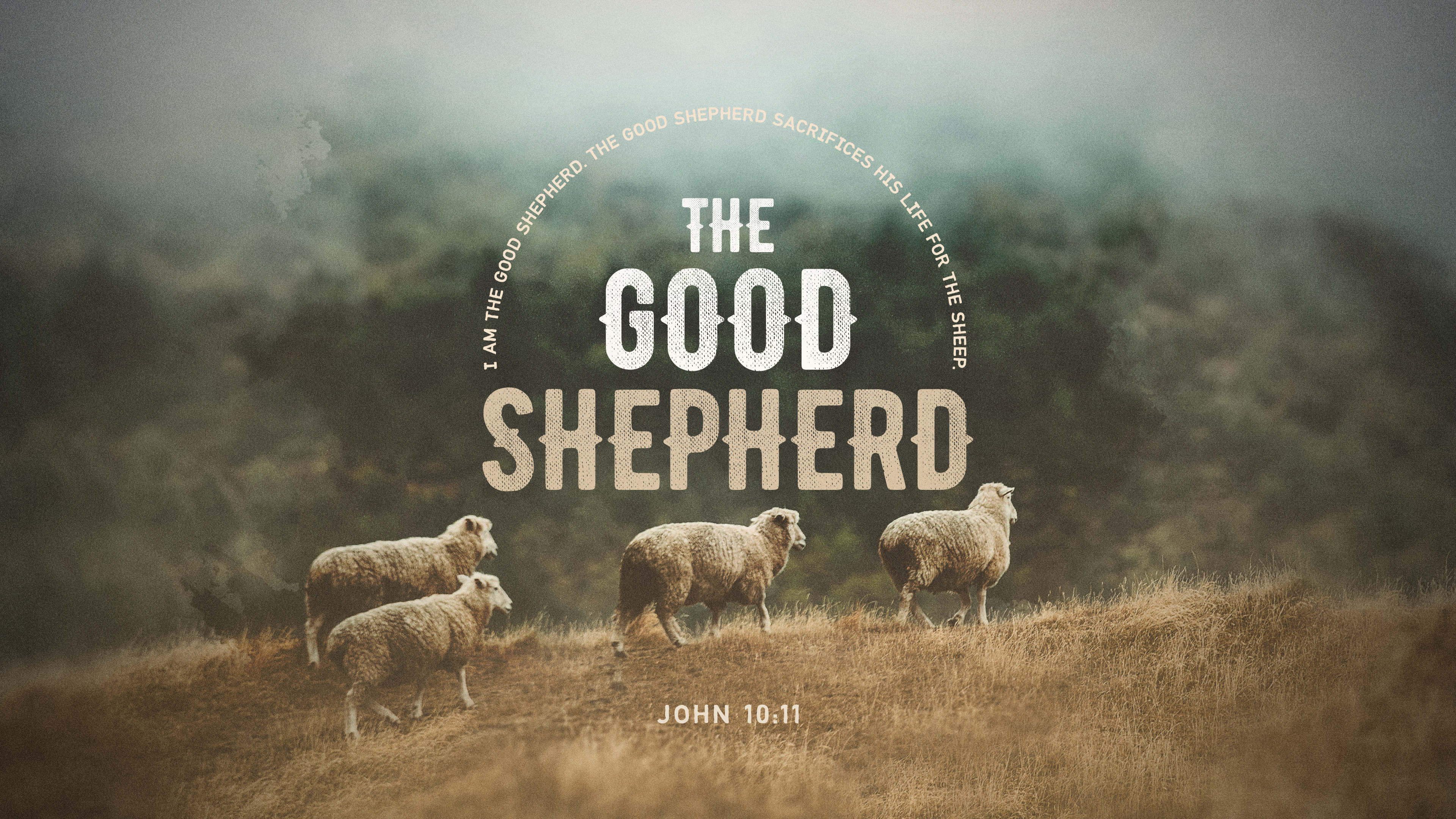
For the next few weeks we will be back in the Gospel of John. This Sunday we will be in John 10 where Jesus makes 2 of his “I Am” statements: I am the gate and I am the good shepherd. These “I Am” statements remind us of the name God gave himself in Exodus 3 – I am that I am. In the “I Am” statements, Jesus is making a clear statement that he is that same God that spoke to Moses, but is now in human flesh.
Shepherds, with their sheep, were a common sight in the ancient near east and were used all throughout scripture to illustrate spiritual truth. Most notably Psalm 23 is a prophetic description of what The Messiah would be like. In Jesus’ claim to be the messiah he identifies himself as not only a shepherd of the sheep, but as The Good Shepherd. The word “good” is the operative word that adds clarity to the kind of shepherd Jesus would be. Good means more than just good at his job, or better in comparison to others. The word good in this statement means the perfect one! The one who is worthy and will fulfill the role of that shepherd perfectly.
The interesting thing about sheep is that they are rather dumb animals and incapable of their own care and protection. In this story, guess who the sheep are? That’s right, it’s us! Shepherds are tasked with the care and protection of the sheep, and Jesus, as our good shepherd will do that perfectly for us. When we admit our need for God’s care and protection, Jesus comes as our good shepherd. Join me this Sunday as we look at Jesus teaching on the Good Shepherd


 andymatt723