March 5th, 2023

Have you ever wondered what it would have been like to be with Jesus and witness first hand one of His miracles? To see him heal the sick, restore sight or walk on the water. Many people today think it would be easier to believe in God today if they could see some kind of a supernatural sign from God. But that is not what Jesus teaches in John 4. In this passage there is a clear emphasis on the Word of God and the need for people to respond in obedience to it. The last verses of Chapter 4 tell of a royal official who had a son that was gravely ill. Jesus tells the man that his son will live. Before the man actually could see his son to verify the healing verse 50 says “The man took Jesus at his word . . .” There is a pattern established in this narrative: faithful obedience to the word of Christ paves the way for God to do a miracle. The same is true for us today. If we want to see God do miracles in our lives, we must be taking God “at His Word” through faithful obedience. For the marriage that needs to be healed, that healing will only come when the people in that marriage are walking in faithful obedience to God. Financial healing will only come when there is faithful obedience to use our resources as God wants us to use them. Emotional healing will only come after we have sought to bring our emotions to God in faithful obedience, expressing our deepest feelings to God and trusting him through our deepest fears. Join us Sunday as we consider what it means to take Jesus “At His Word.

February 12, 2023

John 3 contains some of the most well-known verses in all of scripture: Jesus’ conversation with Nicodemus regarding the necessity of being born again, as well as John 3:16, the most well-known verse in all of scripture (it is on bumper stickers and posters at sporting events.)  As great as those verses are, we lose some of their meaning when we look at them isolated from the rest of the chapter. While we know chapters and verses were not part of the original writings of the Bible, but were added to make references easier, the 36 verses of chapter three definitely are a unified thought. John 3 is written with literary devices that unify the 36 verses, clarifying the deeper meaning they possess. Sunday we will see this chapter starts and concludes with references to things from above, namely Jesus and how the Kingdom is offered through Jesus. John 3 is truly a masterpiece of writing that reveals the beauty of God in profound ways. Join me this Sunday as we consider things “From Above.” 

February 5th, 2023

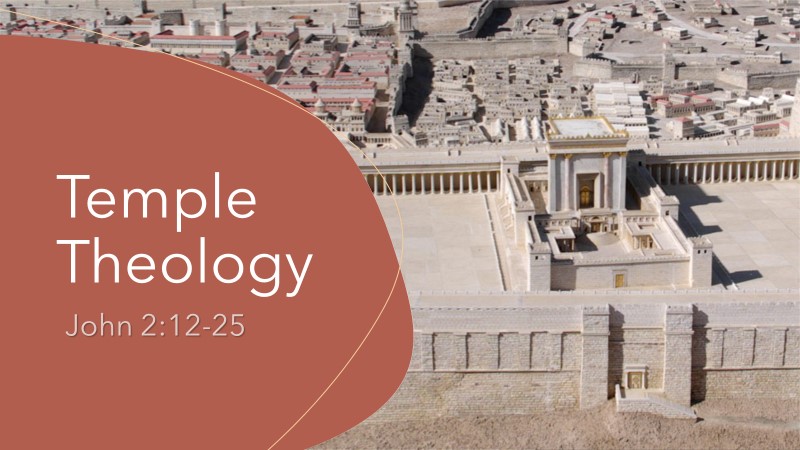
Last Sunday we looked at the first half of John 2 where Jesus turned water into wine. That miracle, His first, revealed the kind of ministry Jesus would have: He is the true source of Joy. The narrative quickly changes gears from Jesus being the life of the party at the wedding in Canna, to a dramatic display of righteous anger over the merchandising taking place in the temple during the Passover feast. Why the drastic change?

The temple provided the answer to the question “How can sinful man have a relationship with a holy God?” The temple became the earthly home of God through much of the Old Testament and through a series of sacrifices or feasts, a repentant person could experience a relationship with God. They could pray and worship him. In John 2, when Jesus arrives at the temple for the feast of Passover, the true purpose of the temple (relationship with God) had been replaced with merchandising and profit seeking. In righteous anger, Jesus took dramatic action.

In this passage Jesus also reveals Himself as the true and perfect temple: the way to relationship with God. Jesus said “destroy this temple and I will raise it again in three days.” The temple sacrifices and traditions merely pointed to what Jesus came to do: to provide the final and complete way for sinful man to have relationship with God. Jesus said, “I am the way, and the truth and the life. No one comes to the Father except through me.” Join me Sunday for this important message on the deep theology of the temple.

January 29, 2023

Why would the first miracle of Jesus appear to be simply an attempt to save friends from a social embarrassment? We know that Jesus would do miracles that served a much greater need for people: sight restored, the lame walked, thousands of hungry people were fed and even raised the dead. In this His first miracle, a wedding feast had run out of wine and would likely have to prematurely come to an end; rather than a feast of four days it was only three. On the surface that is all this seems to be. But I would suggest to you this miracle has a very deep symbolic meaning that was intended to convey the kind of ministry Jesus was going to offer. 

Wine is a symbol of joy all throughout the Bible. The fact that this feast celebrating a marriage had run out of wine is symbolic of the fact that the joy of life in the natural world would prove to be dry and found wanting for true joy. Jesus recreates water into wine which points to His redemptive work on the cross where he recreates in us in a new life that is characterized by joy. Sometimes you will hear preachers warn not to read too much into a passage. John 2:1-11 is an exception to that rule. Almost everything from the day this happened on, to the water pots, to the conversation with Mary, to the role of the servants to how the wine was received has a deeper meaning than what it appears to have on the surface. Join me this Sunday as we continue our journey through John and see Jesus as The Lord of the Wine.

January 22, 2023

The way a person becomes a Christian is the same for everyone: “you must be born again.” We are born again by believing and personally receiving Jesus as our savior and Lord. The path people follow getting to that starting point can be quite different.

In the remainder of John 1, the author is careful to emphasize John the Baptist as the one who gives testimony and is a witness to the fact that Jesus is the promised messiah. John the Baptist testifies regarding things that were public for all people to see as well as one thing that was a direct revelation from God to him regarding who Jesus really is. We all know a claim is only credible if it can be supported and proven to be true. What does a savior need to do to prove they are indeed a savior? They need to save people. What does a Lord need to prove they are indeed the Lord? They need followers that surrender to His Lordship. In the remainder of chapter one that is exactly what the author does; he introduces people who are saved and surrender to Jesus as Lord, proving Jesus as savior and Lord.  

What is interesting is that of the four times people begin to follow Jesus they all come to that place through very different paths. The same is true today! I would love to hear the personal testimony of each person in our church. I know they would all be different and would reveal the creativity of God as he draws people to Himself. As we look to our local mission field, we need to remember that God will use a variety of ways to draw people to himself and not get stuck on just one method to witness to the world around us. Join us this Sunday as we consider how a person can “Follow Jesus.”

January 8th, 2023

My preferred way to preach is to week by week preach through a book of the Bible, paragraph after paragraph, in light of its historical and grammatical context. It is the way the Bible was written and provides the clearest understanding of the text.  This Sunday, I’m excited to start preaching through the Gospel of John in that way. I will occasionally insert a short sermon series on different passages, but the Gospel of John will be our staple for many months ahead of us. 

John’s Gospel is the last of the four Gospels to be written and provides not only different content about the life of Jesus from the other three Gospels, but it also approaches the life of Jesus from a much more personal perspective. While Jesus is fully God, John also shows that he was fully human, with real human relationships as well as the physical, emotional and spiritual struggles similar to what we face as humans. The big difference is Jesus faced all those human struggles perfectly and without sin.  Jesus is the ultimate revelation of who God is: there is no better way to know God than by knowing Jesus. Jesus is also the perfect example of what it means to be a human being: if you want to be a better human being, get to know Jesus better.

The opening 18 verses of this book are often referred to as “The Prologue,” or the introduction. It is more than an introduction to the book, they are John’s introduction to Jesus. This Sunday we will consider the first five verses of the prologue where John refers to Jesus as “The Word”. “Word” in Greek is Logos, which was a well known concept at the time. The Logos was considered to be the source of all that could be known both in the material and philosophical spheres. The opening words of John’s Gospel invite people, from all different backgrounds, to see Jesus as The Logos – The Word – the source of everything. Join me this Sunday for the first message in this series, “Introducing Jesus”. 

December 18th, 2022

Joseph is an interesting person in the Christmas narrative. He is only mentioned a few times in all the gospels but without him the Advent of Christ could not have happened the way it did. Joseph played a critical role in the legitimacy of Jesus’ birth, not only for the sake of Mary’s place in society but to fulfill many Old Testament prophecies about the Messiah.  When we first meet Joseph in the first chapter of Matthew, he is in shock over the news that the woman to whom he was engaged was already pregnant. This was a crisis because he knew the child was not his and had decided a legal divorce was the only course of action. His life would forever be changed. The Angel of the Lord comes to Joseph in a dream with an important message. In spite of being in crisis mode he heard and obeyed the word from God. Matthew 1:18-25 reveals some interesting aspects of Joseph’s life that helped him hear and respond in obedience to the Word of the Lord, even when he was in crisis mode. Many times, the business of life together with the big and smaller crisis we face in life can prevent us from hearing the voice of God. As God sent a message to Joseph, he also has a message for us through the Advent of Christ. A message we could miss if we don’t prepare ourselves to hear the voice of God. Join us this Sunday as we look at the angelic visit to Joseph and Hearing the Voice of God in Advent.

December 11th, 2022

You likely have heard the term “The Glass Ceiling.” It is an unofficially acknowledged barrier to advancement in a profession, especially affecting women and members of minorities.  Part of the effects of the original sin and fall of man are the limits placed on mankind. In Luke 1:26-38 we meet Mary, the mother of Jesus for the first time. It is not an overstatement to say that a woman in Mary’s position, in the first century near east lived with many limitations on her. As a young woman that was engaged she was still under the authority of her father and was preparing to come under the authority of her husband to be, Joseph. Mary was limited by a man’s authority in her education, her business dealings and even the places she could go. But in Luke 1 Mary hears the wonderful news of God’s Advent in the child she would conceive by the Holy Spirit, whose name is Jesus. It was through that child God would fulfill the statement by the Angel, “For nothing is impossible with God.” Advent means that God comes into our lives to overcome sin, and the limitations sin places on us. When we receive Christ through personal surrender, the limitations of sin are replaced by the opportunities God provides for us to glorify Him. Join us this Sunday as we discover how Christmas Brings Limitless Opportunities.

December 4th, 2022

For the remainder of the Advent season I will be sharing messages based on the experiences of the different people involved in the events surrounding the birth of Jesus. Each one of them had a fear or obstacle to overcome. In the advent of Christ they found not only deliverance from thier fear, but with it they found a deep and lasting joy. This Sunday we begin in Luke 1:5-17, with Zechariah, the father of John the Baptist. When we meet Zechariah and his wife Elizabeth in they are elderly, have no children and no prospects of having a family. In that society being without children was considered a punishment from God for some unknown sin. Words like reproach, shame and disgrace are used to characterize them in their community. In the Advent of Christ, the disgrace is countered by the Grace of God that comes at Christmas. Have you experienced those painful words in your life? Reproach – Shame – Disgrace? I think we all have at some point. The Advent message given to Zechariah, as well as to us is that God hears our prayers and remembers our needs. Join us this Sunday as we discover how Christmas Overcomes Our Shame.

Novemeber 27th

Sunday I will wrap up my sermon series on essential doctrines, “Relevant Orthodoxy,” with a message on the Church. There are 34,000 different Christian denominations in the world, highlighting what we already know; there are many different opinions of what the church is. This Sunday it is not my intention to solely promote the “Baptist” conviction of church, although I would be insincere if I didn’t recognize my bias in that direction. As with all the areas of doctrine we have considered in this series,  I want to look at this from the most basic, foundational concepts of what the church is. But I also want to show us the Church in the context of our relationship with God and His high calling for us in the church.  While the Church in America is facing some decline and with the decline some opposition, I believe the greatest days of the church in America are before us. Ephesians 1:15-23 speaks to us of the hope and the calling we have in the church as well as the great power God desires to unleash through His Church. Join me this Sunday as we discover the amazing, the powerful and beautiful Church!