July 3, 2022

This Sunday wraps up the eight week sermon series on the Beatitudes: “A Good Life Amid Moral Chaos.” The beatitudes are the opening statement to Jesus’ Sermon on the Mount, recapping major theological Old Testament themes and showing how they need to be applied to disciples living in this Church Age. The beatitudes are the most significant moral statements ever recorded and have profound impact on our lives today. The term “good life” is anotherway of saying “blessed” and points us to the kind of life God calls us to live. The “good life” is one that lives according to godly virtues as found in these verses.

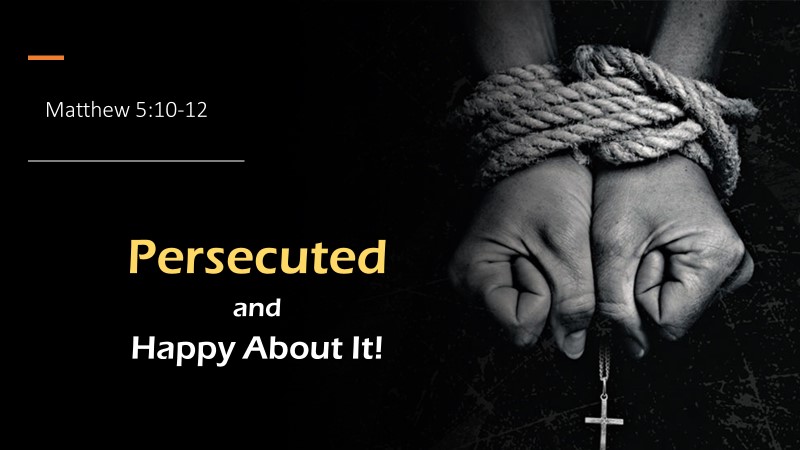
If a person displays the first 7 beatitudes it’s a guarentee they will expereince the last one; persecution. It only makes sense. Living the Beatitudes means you are living counter to the fallen ways of the world and for that reason we will face pushback on our beliefs and our actions. While no one likes the idea of persecution the promise Christ gives is out of this world – the Kingdom of Heaven. The believer will face persecution the more we identify ourselves with Christ, but the more we identify ourseleves with Christ, the more of the Kingdom we will enjoy. Join us this Sunday for the final message in this series,  Persecuted and Happy About It!

June 26th, 2022

Rudolph, the red-nosed reindeer was facing some adversity as he was starting his new life at the North Pole. He was a bit different than “all of the other reindeer”, in that he had a blinking red nose. He quickly became the point of many jokes and nasty name-calling. Furthermore, he was ostracized from the rest of the community – he wasn’t included in the usual reindeer games. You know how the story goes . . .

How do you deal with conflict and adversity? The world can be tough, and society has developed some unhealthy ways of dealing with conflict. Are you familiar with the term “Karen?” (no offense to any real Karen’s reading this.) That term is in reference to a person that is triggered easily and responds to conflict in a disproportionate manner. The other option is to retreat from conflict and be content with relationships that are superficial at best. No one desires to fall into either one of those places but so many people do. Jesus offers an alternative – be a peacemaker.  Join us this Sunday as we consider Peacemaking in An Age of Outrage.

June 19, 2022

We live in an age of self-expression. The Megan Trainor song “I Love Me” depicts societies focus on self: “But I can see it clearer when I’m lookin’ in the mirror, Saying God made me just right, I love me, I love me – I don’t know about you, but baby, I love me.” While it is important to have a healthy self esteem, if we believe everything we think, feel and act on is ok we will progressively fall into deeper and deeper sin and dysfunction, never changing to be what God intended us to be. When Jesus says, “Blessed are the pure in heart for they shall see God,” He is calling us to align better with God’s design for us. In the Bible we see two images that illustrate the concept of purity or the purifying process: pruning and fire. In pruning, the unproductive branches are removed so more fruit can be produced. Fire is used to refine alloy by heating it to a degree that the lesser material is removed to leave only the gold. Both pruning and a refiner’s fire are a process of removing something to achieve a desired result. Purity in the spiritual life is about removing the aspects of our lives that don’t align with God and his righteousness. Spiritual purity flies in the face of the self-expressive age we are living, and as with all the beatitudes, purity is counter to the values and actions of the society we live in. But purity is worth it. Why? Because look what we get – we will see God. Join us this Sunday for part 5 of this sermon series on the beatitudes: Purity in An Age of Self-Expression.

June 12, 2022

Mercy is the chief characteristic of God in the Old Testament. That’s right! It’s not His wrath but His mercy that prevails in describing God through those 39 books. Unfortunately, mercy is a misunderstood concept in our society, making it difficult to comprehend this vital biblical truth. Many states (not North Carolina) have what is called a No Fault car insurance which avoids assessing blame on either of the drivers involved in an accident. Society has adopted a “mercy light” version of mercy that is characterised by tolerance, attempting to  gloss over guilt. But is it possible to experience true mercy without first acknowledging guilt?  The mercy that describes God in the Old Testament does not gloss over sin or the guilt that comes with it. As a matter of fact, guilt must first be acknowledged before a person could enjoy the blessings of God’s mercy. Furthermore, God’s righteous holiness must be respected by the just punishment of that guilt. That is where mercy comes in. The gospel reveals the mercy of God in that when we acknowledge the guilt of our sin before a holy God, Christ becomes the object of God’s wrath on the cross so we can experience the radical love of God in the forgiveness of our sins. If we only ask God to tolerate our sins, His divine wrath is never satisfied and we would remain hopelessly separated from him. And how do we know if we have genuinely received the mercy of God? You will joyfully offer mercy to those that are burdened with guilt from a sin against you – something that can only be done in our lives through a supernatural work of God. Join us this Sunday as we take a deep dive into the refreshing waters of God’s Mercy.

June 5, 2022

Values are a popular concept today. It is used all the way from our highest-ranking elected officials to multibillion-dollar corporations, to philanthropists, to non-profit organizations, churches, and right down to the individuals. You could say there is a buffet of values today! Values encapsulate the purpose and goals of the person or group. Stating their values serves as a rutter that directs decisions and how resources are used. Values point to morals.

As the culture shifts to be more secular, we find the values of individuals or groups are often in conflict with the virtues of Scripture: when life begins, gender, marriage, the family, work ethic, the origin of the universe just to name a few. There is an attempt to have morals without God – But I would respectfully present to you that is an impossibility!

In 1896 George Jacob Holyoake, an atheist and coiner of the term Secularism, insisted it is possible to do good apart from God, saying, “It is good to do good.” What good was he referring to? Reflecting on what is good for secularists, sociologist Phil Zuckerman said, “The answer is simple: the Golden Rule. Being good means treating others as we would like to be treated. That is the bedrock of secular morality.” And who could argue that is not a good thing to do. However, unbeknownst to Zuckerman, the Golden Rule is taken from the Sermon on the Mount – Matthew 7:12 “So in everything, do to others what you would have them do to you, for this sums up the Law and the Prophets.” What we see here is that there can be no true and lasting values or virtues or morals that are not based on God. For the Christian, our values need to be based on the virtue of Christ and the doctrine that is revealed in Holy Scripture.

Sunday, we are talking about the pursuit of righteousness. This righteousness is not subjective or individualistic. It is a clear reference to what is RIGHT based on the person and character of God! God himself is righteousness! He is always right! It is impossible for him to be wrong!  God himself is the standard of what is right! Jesus’ promise is that hunger and thirst for righteousness shall be satisfied. Join us this Sunday as we find lasting satisfaction for our deepest hungers.